
Car Insurance for Retired Couples — Levittown, PA
Free to compare
When Both Policies Still Reflect Commuter-Era Assumptions
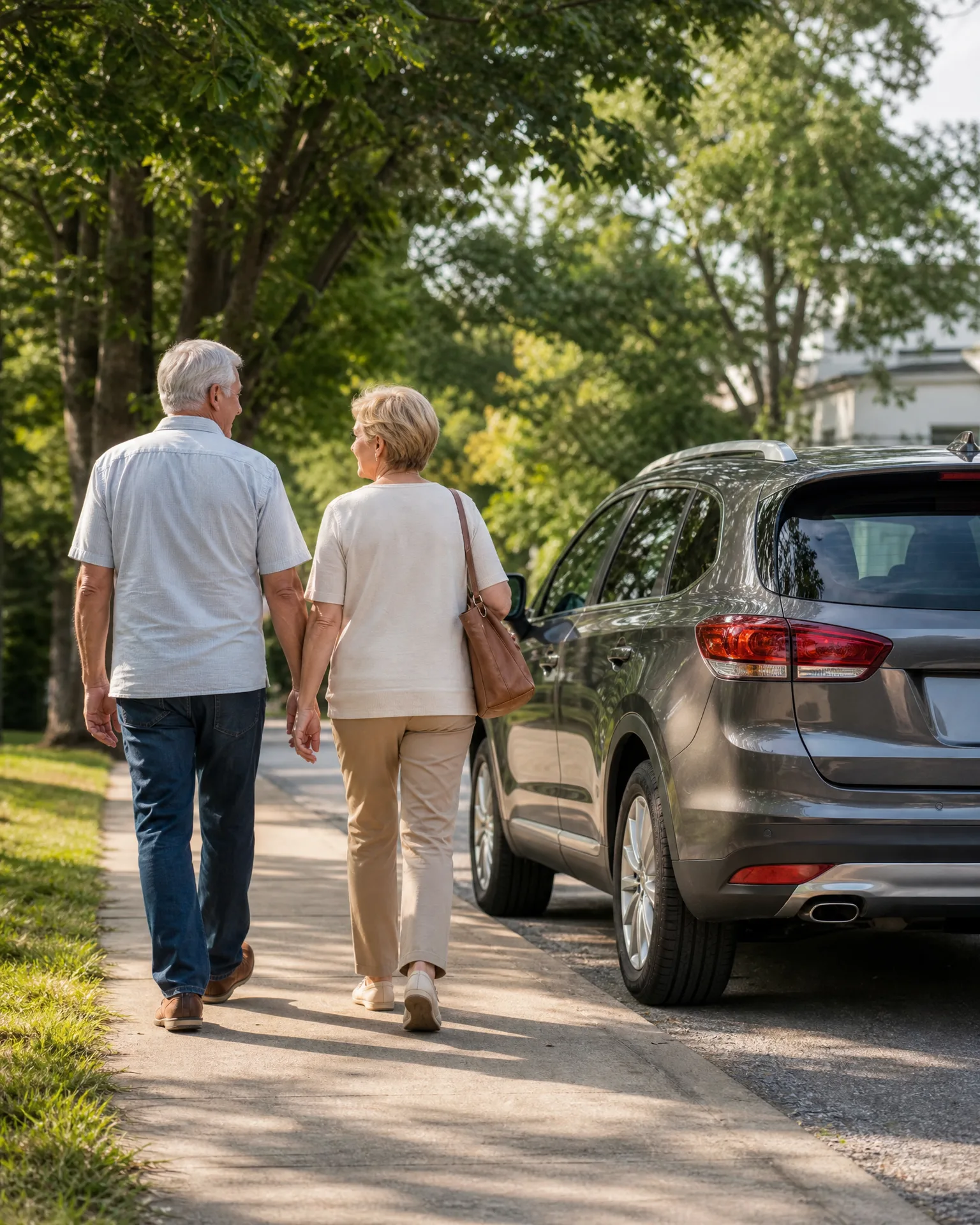
You opened your renewal notice and saw the same premium you carried when both of you drove to work every day. One vehicle is paid off. The other barely leaves the driveway except for groceries and medical appointments. Yet both policies still carry collision, comprehensive, and coverage limits built for a household that no longer exists.
Most retired couples in Levittown maintain duplicate full-coverage policies because no one told them the structure could change. The agent renews what existed last year. The premium creeps up. The household pays twice for coverage protecting assets that no longer require it, or protecting a second driver whose mileage dropped to near-zero when the commute ended.
“Most couples overpay by duplicating full coverage when one driver could shift to liability-only, cutting household cost while preserving protection.”
Lower Your Rate as a Retired Pennsylvania Driver
Get My Pennsylvania Retiree Auto Insurance Quote5%
PA Statutory Mature-Driver Discount Floor
Pennsylvania law requires insurers to offer at least a 5% discount to operators age 55 and older who complete a state-approved defensive driving course. The discount applies per driver, not per household, so both spouses can qualify independently.
75 Pa.C.S. §1799.2
The Structural Reality Most Couples Miss
Pennsylvania treats each named driver and each vehicle as a separate underwriting decision. Your household policy is not a fixed unit. One spouse can carry full coverage on the primary vehicle while the other maintains liability-only coverage on a paid-off second car. One driver can be excluded entirely if they no longer drive, which removes their premium contribution and eliminates their exposure as a rated risk.
The mature-driver discount Pennsylvania mandates is age-based, triggered by completing an approved defensive driving course. Both spouses qualify independently once they turn 55, but the discount does not apply automatically. You submit the course completion certificate to your carrier. If you completed the course three years ago and never resubmitted when it expired, you are paying the higher rate right now.
Most couples assume Medicare replaces the need for medical payments coverage. It does not. Medicare covers your injuries regardless of fault, but medical payments coverage on your auto policy pays deductibles, copays, and expenses Medicare does not cover. For a retired couple on a fixed income, a $5,000 out-of-pocket cap can matter more than it did during working years.
The unresolved question: does the paid-off vehicle still justify paying for collision and comprehensive, or does liability-only coverage protect what actually needs protecting now?
Related Articles







The Path Through Pennsylvania's Mature-Driver Discount System
Pennsylvania law requires every insurer writing auto policies in the state to offer the mature-driver discount. The statutory floor is 5%. Some carriers exceed it. You will not know your carrier's filed amount until you ask, because the percentage does not appear on your declarations page unless the discount is already applied.
The discount triggers when you complete a state-approved defensive driving course and submit the completion certificate to your carrier. Pennsylvania does not maintain a single statewide approved-course list published by PennDOT; approval is handled at the carrier level. Before enrolling, confirm with your insurer which course providers they accept. AARP and National Safety Council courses are widely accepted, but acceptance is not universal.
The certificate does not last forever. Most carriers honor it for three years, then require resubmission. If your last course was in 2022 and you have not re-enrolled, the discount lapsed at your 2025 renewal and you are paying the undiscounted rate now. The renewal notice will not tell you the discount expired. You learn it when you call and ask why the premium increased.
Both spouses qualify independently. If both of you are 55 or older, both of you can complete the course and both of you receive the discount. The household benefit compounds. One certificate covering one driver saves 5% on that driver's portion of the premium. Two certificates save 5% on both.
25
Carriers Writing Auto Policies in PA
Twenty-five carriers are verified writing personal auto insurance in Pennsylvania as of current data. Not all offer identical mature-driver or low-mileage programs. Comparing three carriers that specialize in senior or low-mileage profiles often surfaces a lower household premium than renewing with the carrier you have carried since your 40s.
Carrier licensure data, Pennsylvania Department of Insurance

When One Spouse Stops Driving Entirely
If one spouse has surrendered their license or no longer drives for medical reasons, two paths exist. Path one: exclude that spouse from the policy as a named driver. The exclusion removes them as a rated risk, which lowers the household premium, but also bars them from driving any vehicle on the policy. If they get behind the wheel and cause an accident, the policy will not cover it.
Path two: maintain both spouses as named drivers but drop to a single vehicle. The non-driving spouse remains insured and legal if they need to drive in an emergency, but the household no longer pays to insure a second car that never moves. This works when one vehicle meets all household needs and the second car was kept only out of inertia.
Collision and Comprehensive on a Paid-Off Vehicle
A 2015 Honda Accord in good condition is worth roughly $8,000 in Levittown today. Collision and comprehensive coverage on that vehicle costs perhaps $600 to $900 annually, depending on your deductible and the carrier's filed rates for your ZIP code. After ten years of paying that premium, you have spent more insuring the car than the car is worth.
The judgment call: can you replace the vehicle out-of-pocket if you cause an accident or it is stolen? If yes, liability-only coverage is the structurally correct choice. You stop paying to protect an asset whose replacement cost is lower than the cumulative premium. If no, because retirement savings are allocated elsewhere and an $8,000 loss would force difficult decisions, keep collision and comprehensive and accept the annual cost as the price of not bearing that risk yourself.
This is not an age question. It is an asset question. A 45-year-old with a paid-off car faces the same math. The difference for retirees in Levittown is that income is often fixed, discretionary savings are finite, and paying $700 a year to protect a $7,000 asset starts to look like spending a dollar to protect a dollar.

The Next Step for Your Household
Pull your current declarations page and identify which vehicles carry collision and comprehensive, what each vehicle is worth today, and whether both drivers are still driving regularly. If one car is paid off and lightly driven, request a quote for liability-only coverage on that vehicle and compare the annual savings against the replacement cost if you total it.
Confirm whether you and your spouse have submitted mature-driver course certificates in the past three years. If not, enroll in a state-approved course your carrier accepts, complete it, and submit the certificate before your next renewal. If the course expired, re-enroll now so the discount applies at renewal rather than six months later when you remember to ask.
Compare your current carrier against three others writing in Pennsylvania that offer low-mileage or usage-based programs for retired drivers. Your household may qualify for mileage-based discounts your current carrier does not offer, or a competitor may rate your profile more favorably now that both of you drive under 7,000 miles a year. Request quotes structured to match your actual household: one full-coverage vehicle, one liability-only, both drivers over 55 with course certificates on file.
Comparing Household Coverage Structures
Structure one: both drivers maintain full coverage on both vehicles. This is the commuter-era default most couples carry into retirement without reassessing. It makes sense only when both vehicles are financed, leased, or worth enough that replacing one out-of-pocket would strain retirement savings. If one car is a paid-off 2015 sedan worth $6,000, you are paying collision and comprehensive premiums to protect an asset you could replace for less than two years of coverage cost.
Structure two: primary driver carries full coverage on the primary vehicle; secondary driver shifts to liability-only on the paid-off car. This is the most common post-retirement adjustment. The household maintains collision and comprehensive where it protects a real asset, drops it where the vehicle value no longer justifies the premium, and both drivers remain insured and legal. The secondary vehicle stays registered, titled, and usable; you simply stop paying to repair or replace it if you cause the accident.
Get Your Free Quote
Get My Pennsylvania Retiree Auto Insurance QuoteFrequently Asked Questions
Does Pennsylvania require insurers to offer a senior discount?
Yes. Pennsylvania law requires insurers to offer at least a 5% discount to operators age 55 and older who complete a state-approved defensive driving course. The discount applies per driver, so both spouses in a retired couple can qualify independently by completing the course and submitting their certificates.
Can one spouse drop collision coverage while the other keeps it?
Yes. Pennsylvania treats each vehicle and each driver as a separate underwriting decision. One spouse can maintain full coverage on a financed or high-value vehicle while the other carries liability-only on a paid-off car. The household policy structure is not fixed; you can request different coverage levels for different vehicles.
What happens if my mature-driver course certificate expires?
Most carriers honor the certificate for three years, then require resubmission. If your certificate expired and you have not re-enrolled, the discount lapsed at your most recent renewal and you are paying the higher rate now. The renewal notice will not tell you the discount expired; you learn it when you call and ask.
Should retired couples keep medical payments coverage if they have Medicare?
Yes, in most cases. Medicare covers your injuries regardless of fault, but medical payments coverage on your auto policy pays deductibles, copays, and expenses Medicare does not cover. For a retired couple on a fixed income, a $5,000 out-of-pocket cap can matter more than during working years.
Can I exclude my spouse from the policy if they stopped driving?
Yes. If one spouse has surrendered their license or no longer drives, you can request a named-driver exclusion. The exclusion removes them as a rated risk and lowers your premium, but also bars them from driving any vehicle on the policy. If they get behind the wheel and cause an accident, the policy will not cover it.
How do I know if collision coverage still makes sense on a paid-off car?
Compare the vehicle's current value against the annual cost of collision and comprehensive coverage. If the car is worth $7,000 and coverage costs $700 per year, after ten years you have paid more in premiums than the car is worth. The judgment call: can you replace the vehicle out-of-pocket if you cause an accident? If yes, liability-only is structurally correct.